Powered By Blogger

Friday, 2 January 2015

The Silent Woman. The weight of every word.
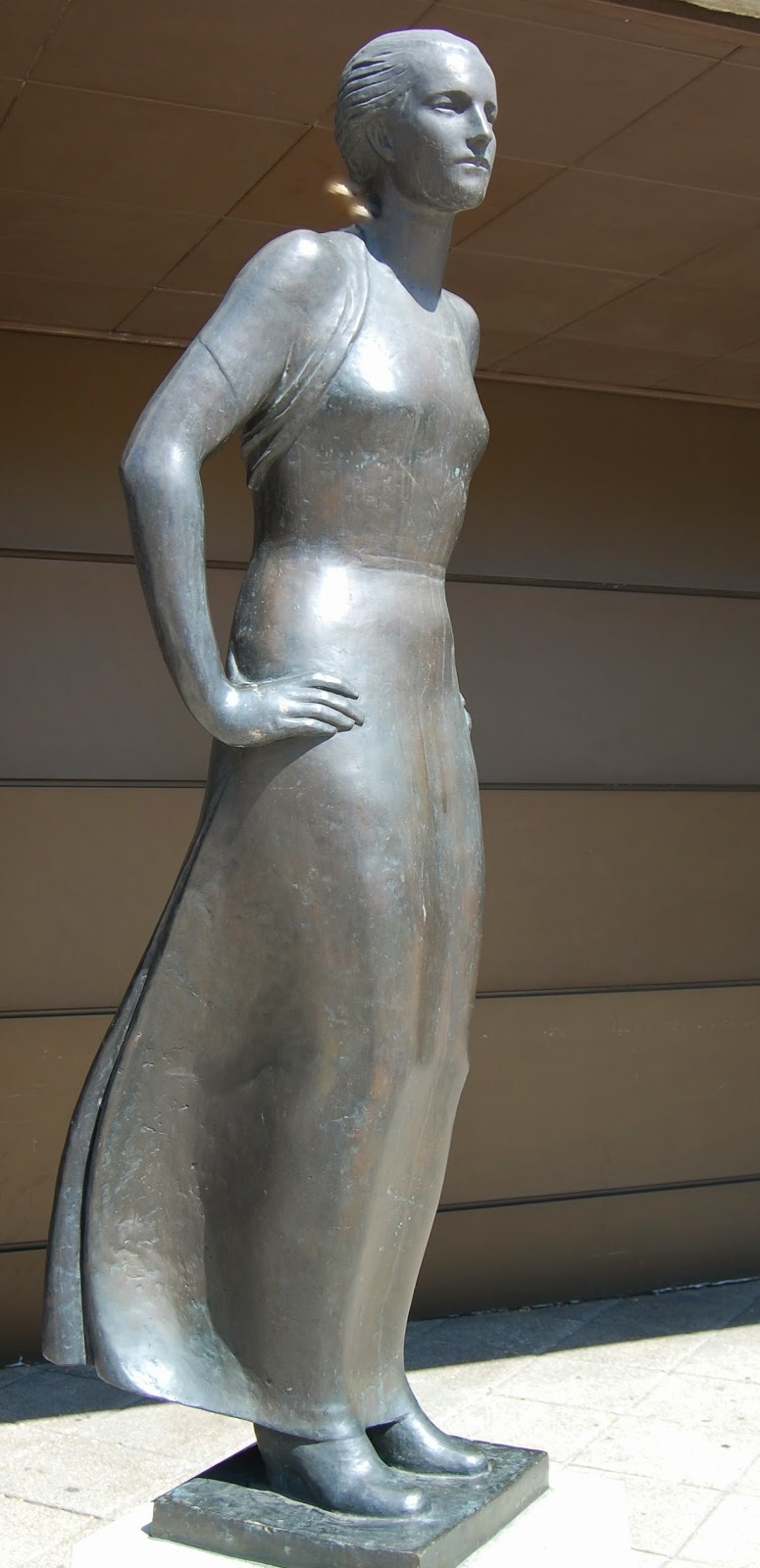
‘I love the child; but she is afraid of me.’ So begins one of Walter Wangerin’s dramatic monologues (in Ragman and Other Cries of Faith, Zondervan, revised edition 2003). It speaks of God thinking through how he might approach the young Mary. She is his chosen but he worries that fear of him might turn that blessing into a curse. He resolves that only through the bearing of a baby can her personality and will be truly honoured. Only in the tenderness and care that is her gift and intention can God be born.

I thought of that story often as I read Marilynne Robinson’s Lila. For much of the novel Lila is pregnant. What this new life to be means for her and her aged preacher husband, John Ames, is a recurrent theme. Like Mary in the Wangerin story, fear haunts Lila. There is about her a profound aloneness that colours every part of her experience. The child is for her the only possible way out of that isolation. Although her marriage is clearly a deeply loving relationship, somehow she and her husband fail again and again to meaningfully connect thoughts and words.

Perhaps their struggle to express themselves to each other finds its origin in their very different understanding of language. Lila thinks hard and long on life but does not have the words to articulate her thoughts. Indeed, for her not speaking is a kind of liberation. Not knowing the right word is her repeated experience. The old man (as she often refers to him) is the opposite. A preacher with long years of practice he is well versed in the art, and the precision of words. A lifetime of study, conversation and prayer has made him, body as much as mind and soul, as he is: ‘His preaching was a sort of pattern of his mind, like the lines of his face.’

Lila has the life experience but cannot articulate it. The Reverend is all articulation and worries that he has underplayed life’s profundities. Again and again, as the story unfolds in a realm apparently unrelated to any particular historical epoch, the questions of meaning, trust and trustworthiness are played out. Eternal verities laid bare in the story of one impoverished, and often silent, woman.


Lila – a novel and a theology.

Friday, 28 September 2012

What's in a Picture?

Ruth is one of the books of the Bible that particularly appeals to me. It's a delightful short story - easy to read and with a down-to-earth quality to it that is immediately engaging. It seems to me to be obviously the work of a wise women. Even those who would argue with that must surely admit that Ruth provides a much needed woman's perspective when it comes to biblical voices.

A good choice, therefore, for a Quiet Day about pastoral ministry just before the admission and licensing of new Lay Pastoral Workers in the diocese in which I work. And the days I've spent researching Ruth haven't disappointed. I'll leave readers to judge for themselves whether the sermon created from this study was worth the effort - you can access it here (the Quiet Day addresses are rather more 'off the cuff' so I haven't posted them).
The reason behind this post, however, is the differences I've noticed in the ways a much loved Ruth poster of yester-year has been reproduced. A reputable art print company supplied me with a poster for the use of tomorrow's group. This is the image:
It's a reproduction of Ruth and Naomi, a painting from 1886 by Philip Hermogenes Calderon (1933-1898) in the collection of the Walker Art Gallery, Liverpool. Except when I compare it to the gallery's own website (see National Art Collection) I realise the image I have has been changed: in particular sunshine appears in the top left, there are many more green plants among the rocks and on the hillside, the colour of the clothing of the lone figure has been changed, the race of the lone figure has been changed, and the head-wear of the taller one of the embracing couple has been changed. I think the changes make the image more immediately one of hope and new beginnings. The third person becomes an unnamed servant carrying her mistress' burden, Orpah is nowhere to be seen, and Ruth and Naomi are pulling apart prior to their walking on towards new life in Bethlehem (symbolised by sunlight). The Calderon original is all together more ambiguous - an ambiguity that did not fit the purpose of the Edwardian poster that adorned the walls of so many Christian homes.

Monday, 27 August 2012

On not remembering Apollo 11

The tributes to Neil Armstrong have been remarkable. His self-effacing and courageous character has shone through in what's been said and written. There is something immense compelling in a universally known hero always apparently describing himself as 'a nerdy engineer.'

(C) NASA Apollo 11 mission patch

Prompted by all the news items, I've tried to remember that amazing day in July 1969 when Armstrong stepped on the moon. So many people have recounted how moved they were at the time by the grainy TV pictures. Indeed, not a small number have said how that moment was a personal turning point - an astrophysicist interviewed on the radio gave moving testimony to Armstrong's first step as being her childhood first step towards her career. All the more disconcerting then that I have no recollection from the time of that famous first step.

Of course I have images in my mind of the landing craft ladder and Armstrong stepping from it, of footsteps in the lunar dust, and the stars and stripes waving against a black space and bare lunar landscape, but they are images from oft repeated public display. I have no recollection whatsoever of seeing them for the first time on that fateful day. I suppose I must have seen them then - as a family we watched the television news every day - but I can't remember having done so.

Apparently this makes me something of an oddity. Amongst those old enough to remember 1969, just about every seems to have some memory of the day of the first step on the moon. After all 'What were you doing the day that such and such a famous thing happened?' is a frequent conversational gambit whenever personal memories are talked about.

It's not that I wasn't interested. As a child I was an avid reader of The Children's Newspaper and The Eagle, so science, space and technology were part of my everyday enthusiasms. I was mid-way through secondary school in 1969 and was well aware of the significance of the event - politically as well scientifically. But for some reason a memory of the day itself escapes me.

I know enough of what happened that day to reconstruct it as if it were a memory. Like everyone else I'm familiar with the TV shots of the actual event, and that weekend was the first one of the long school holiday that year. I know what I was likely to have been doing, where I lived at the time, and where and how I was likley to have watched the news report. It would be easy to create 'a memory' of that day, but it would not be a genuine recollection. Interestingly if I did so, I might well come to believe over time that what I had made up was a genuine memory. I can't be absolutely sure of how many of my 'genuine memories' I have actually constructed in just such a way. That one of the really disconcerting things about memory.

I also ask myself why I don't remember anything of the Apollo 11 moon landing. Other days of that decade I remember with great clarity - Winston Churchill's funeral, for example. Is it that something else that was particularly significant was going on in my life at the same time and has obscured my memory of the much talked about moon landing? Maybe that is the case, although I can't actually remember what it might have been. For sure my teenager years were emotionally turbulent - as they are for so many people - so perhaps others things got in the way of my remembering. I just don't know.

My not remembering the Apollo 11 landing illustrates how plastic memory is. Memory is always something we construct and not simply retrieval of pre-existent, pre-formed files. It's a disarming fact that memory making is often as easy as forgetting.

Wednesday, 22 August 2012

Olympian Preaching

Like so many people I guess I've got a touch of post-Olympic blues. So inspiring and encompassing were the games that I'm now missing them terribly. Of course I couldn't have kept up my level of engagement indefinitely - I was able to have my holidays at the games and every holiday has to end! Having enjoyed the Olympics so much my mind turns to what I as a preacher might take from those high days. I think especially about the competitors themselves:
  • Their commitment was transparent and no onlooker could doubt the personal cost and effort involved. Shouldn't preachers be similarly transparent? Do I look committed to what I'm doing?
  • The long-term planning involved was also witnessed to time and time again. The event might only take minutes but the preparation takes years. Doesn't preaching also involve long-term and tenacious preparation? Is my life obviously dedicated to the preaching event?
  • The training undergone was not only long-term but also carefully devised and executed. We heard stories of many different disciplines, sometimes a long way from the athletes own, being used to develop skills and concentration. Are we preachers sometimes lacking both in focus and breadth in our our own training? And are we determined enough in training for the homiletic task?
  • All embracing determination in performance was also clear in every event. Those who knew they were extremely unlikely to end up in the top three still performed to the highest possible standard. Personal 'bests' were achieved time and time again. How might that attitude be translated to the pulpit? Are we preachers clearly repeatedly trying to better our performance for the good of those with whom we work?
  • Fluency in performance was another impressive aspect of every competitor. Certainly there were mistakes occasionally, but generally we were treated to fluent, graceful, and even beautiful renditions of sporting prowess. What had been learnt and developed in training wasn't laboured in the event, but rather had been seemlessly incorporated into what was done. Likewise congregations need fluent even beautiful performances from their preachers. Are we sometimes too laboured and patronizing in how we present? How do we better engage and encompass people by the fluency of what we do?
  • Enjoyment was also obvious. Who could fail to be impressed by so many competitors who said something like I haven't won but I have competed to the best that I possible can and I'm blessed by it. Are we preachers giving our all in a way that satisfies ourselves?  Are we clearly enjoying the action that God has asked of us?
Olympian preaching is perhaps a metaphor worth pondering. Roll on the Paralympics! 

Friday, 22 June 2012

cLectio

'Say one for me, Vicar, will ya?' That often repeated shout from the local milkman as I walked to church each morning to pray the morning office was a great ecnouragement. Looking back I wish I'd told him so. Similar encouragement came also from the small band of people who at different times joined me in the saying of those prayers. Add to that those who asked for prayer or others who commented on the reassurance they drew from hearing the church bell, and the saying of the office was far from a solitary affair. The theological point that prayer is always a 'joining-in' rather than an isolated action, was made real in those things.
Is there any way that such encouragment can be emulated in the rythmns and demands of a so called sector post. I've been toying with what social media may offer here. I've been tweeting a thought from one of the portions of the daily continuous reading of scripture in the hope of prompting some others. Nothing grandly theological - just something to help me think on the passage during the day, as well as being something to slow down my solitary saying of the office. I've called it cLectio - a little thought from the lectio continua of the day. At the moment the Church of England lectionary points me to Judges. Any chance we might cLectio together? Tweet @theosoc.

Tuesday, 19 June 2012

Bible illiteracy

The Bible has dropped out of common cultural currency. Even principle biblical characters and stories are no longer widely known.  So runs the argument about biblical literacy, and its wrong says Dr Katie Edwards. In fact, says Edwards, biblical motifs are everwhere in advertising. Indeed biblical images are particularly prominent in adverts directed at younger people which suggests that their designers believe such images readily connect with the young. Far from being biblically illiterate the 'old, old story' still has an impact on the young. Those who bemoan the silencing of the Bible in contemporary culture have got it wrong, according to Edwards. The cultural pessmists have got it wrong because they are looking in the wrong places and don't give sufficient regard or value to popular culture. The biblical illiteracy argument is one produced out of a certain cultural elitism that doesn't take anything 'pop' seriously.

Dr Edwards made her  case strongly at a presentation at the College of Preachers national conference on 18 June. A quick Google search seems to support her contention that biblical images are everythere in adverts. This one came up with just a couple of clicks. Adam and Eve, Mary, Jesus, and other references do abound. And yes, they often do seem to be directed towards people of 30 and under, so someone somewhere knows that they connect. Certainly it is too easy to dismiss the power of some biblical motifs, and the church is reticent about putting those motifs 'out there' in ways that readily connect. Respectful hesitance is perhaps a a screen for cultural elitism. I'm not sure, however, that the prevalence of a relatively few biblical motifs, however frequently repeated, necessarily overturns the observation that the cultural memory of the Bible is fading fast in contemporary Western society. I need to know more and look forward to learning more of Dr Edwards' analysis. What a great event the College of Preachers conference is.

Wednesday, 30 May 2012

Engaging the Powers.

Four quotations:

Intercession is spiritual defiance of what is, in the name of what God has promised.  Intercession visualizes an alternative future to the one apparently fated by the momentum of current contradictory forces.  It infuses the air of a time yet to be into the suffocationg atmosphere of the present.

History belongs to the intercessors, who believe the future into being.  This is not simply a religious statement.  It is as true of the communists or capitalists or anarchists as it is of Christians.  The future belongs to whoever can envision in the manifold of its potentials a new and desirable possibility, which faith then fixes upon as inevitable.

All this about our role as intercessors in creating history is arrogant bravado unless we recognize that it is God rather than ourselves who initiates prayer, and that it is God's power, not ours, that answers to the world's needs.  We are always preceded in intercession.  God is always already praying within us.  When we turn to pray, it is already the second step of prayer.

Prayer in the face of the Powers is a spiritual war of attrition.  ...  In a field of such titanic forces, it makes no sense to cling to small hopes.  We are emboldened to ask for something bigger.  The same faith that looks clear-eyed at the immensity of the forces arrayed against God is the faith that affirms God's miracle-working power.  Trust in miracles is, in fact, the only rational stance in a world that is infinitely responsive to God's incessant lures.  We are commissioned to pray for miracles because nothing less is sufficient.  We pray to God, not because we understand these mysteries, but because we have learned from our tradition and from experience that God, indeed is sufficient for us, whatever the Powers may do.

All come from the Biblical scholar Walter Wink's amazing book Engaging the Powers: Discernment and Resistance in a World of Domination (Fortress Press, 1992). Wink died earlier this month, aged 76, after a long struggle with dementia.  In his American homeland he was a controversial figure - loved by many and loathed by others.  To me he was the person who first made me understand the political necessity of intercessory prayer. From him I learnt that prayer is a calling into being of an order of existence that refuses to allow evil and hurt to have a determining power over humanity. He inspired me pray as one who refuses authority to the powers of harm and despair, and to look to God's victory in all things - even when it's impossible to see it. He taught me to pray for a peaceful alternative, even when I can't voice what that alternative is. I thank God for Walter Wink's inspiration.  May he rest in that godly peace for which he taught us to long with prayerful passion.

Tuesday, 22 May 2012

Daily Scripture in a twitter

'As a whole the Scriptures are God's revealing Word. Only in the infiniteness of its inner relationships, in the connection of Old and New Testaments, of promise and fulfilment, sacrifice and law, law and gospel, cross and resurrection, faith and obedience, having and hoping, will the full witness to Jesus Christ the Lord be perceived.' So wrote Dietrich Bonhoeffer in Life Together (page 36, SCM Press 1965 edition), that small but profound manual of communal learning he wrote out of the life of the seminary he led at Finkenwalde in the years immediately before the outbreak of the Second World War. It's one of those books I come back to again and again, as I guess many other people do as well.

The quote comes from the section in which he describes the importance of lectio continua - the consecutive reading of Scripture. For me such reading arises out of the prayer of the Daily Office, generally a solitary action. According to Bonhoeffer what is done alone comes to its most productive through what is done in community. I've been wondering how that could be translated into the digital age.

In preparing a sermon I always begin with the Bibilical passage and what issues or questions it suggests to me. I scribble down as many as I can without any prior research or any attempt at ordering or prioritizing (that comes later). I'm conscious, however, that I don't do any of that in consecutive Scriptural reading. Perhaps if I did, my reading wouldn't feel so rushed and peremptory. Bonhoeffer taught that such reading should not serve a purpose but should be for its own sake entirely. I recognize the value of the warning but perhaps he would allow me a slight adaption of a purposeful methodology. As an experiment, I'm going to tweet a thought or question out of my daily reading. They'll aim to be 'instant thoughts' - one believer's attempt to frame something that can mindfully stay with me through the day. Anyone out there willing to join to me?  

Sunday, 13 May 2012

An innovating faith?

‘As you’ve shown an interest in innovation, you might like to know about the savings available on these books.’ Such was the tenor of an email I’ve just received from Amazon. Quite flattering really! Innovation is one of those terms that figures somewhere in the news every day. Indeed last week on several days the BBC ran four or more stories where ‘innovation’ was a key component. Innovation is one of those things that appear to be an unquestionable good. And that’s where Amazon’s data collection about my interests breaks down. For every Christian, innovation, when it’s applied to faith is a problem.

Maurice Halbwachs, the French sociologist of social memory, detailed the issue many years ago. Christianity, he said, is essentially the commemoration of the life of Jesus. This one event in all its complexity and detail is immutable. Jesus happened and, until Jesus returns, that happening remains set in time and cannot be changed. Whatever Christians do and say must always refer back to this happening. Innovation in the usual understanding of the word is simply impossible. Authentic faith must always locate itself in the teaching and life of the person Jesus. Should I as a Christian have any interest in innovation at all?

Halbwachs went on to say, however, that no institution that seeks permanence can be entirely orientated to the past. No matter how much effort is put in, memory is always attenuated over time. Even constant reference to a past event cannot stop that event fading both in content and significance. According to Halbwachs, social memory must always serve current needs if it is to be kept alive as a memory. The remarkable thing about Christianity, Halbwachs said, is the way it interpreted Christ as a constant presence even from its earliest days. Either through a constant and guarded emphasis on truth in church teaching, or through a mystical appeal to a believer’s interior connection to Jesus and his intentions, the church both formularises and lives the tradition – though those streams are often at odds with one another. Peculiarly this constancy enables innovation, since it allows current needs to be expressed as a refreshment of the Christian inheritance. Perhaps I should look more carefully at those Amazon bargain titles.

Friday, 11 May 2012

When is a sermon a sermon?

The Bank of England should have done more to prevent the banking crisis according to its Governor, Sir Mervyn King, speaking in the Today Programme Annual Lecture at the beginning of the month. But, he continued because banking regulation had been removed from its powers, the Bank of England was limited to ‘publishing reports and preaching sermons.’  ‘And we did preach sermons about the risks,’ he said, but the Old Lady of Threadneedle Street should have ‘shouted from the rooftops.’ The inference is clear: the preaching of sermons doesn’t change anything.
King gave his lecture a three-part structure: what went wrong? What are the lessons? What needs to change? The way forward he offered was similarly tripartite: regulation; resolution; restructuring – his 3Rs helpfully alliterative. Here’s a speaker who knows the value of mnemonic devises.
Early on in the talk there was a jokey aside addressed to a Today programme journalist – a nice human touch. Throughout there were simple pithy and memorable phrases: ‘take away the punchbpowl just as the next party is getting going;’ ‘a case of heads I win, tails you – the taxpayer – loses;’ ‘shouted from the rooftops.’ Here’s a speaker who can translate hard ideas into down-to-earth and catchy phrases.
And all this carefully illustrated not only by reference to recent events but also via appeal to historical characters: Montagu Norman, late 1930s Governor of the Bank of England and US President Roosevelt speaking in 1933.
Banking may not be the subject that immediately comes to mind as the topic for an engaging and memorable speech, but this certainly was. King’s presentation, in its delivery, content and structure was immensely listenable. In fact you could say it was a sermon, or at the least a lecture that employed many homiletic strategies. Perhaps preaching has more significance than even the users of its techniques appreciate.

Tuesday, 1 May 2012

Say it like Sarah Lund


I’m one of the millions of fans of Sarah Lund – the uncompromising, uncommunicative, and unsocial detective who leads in the hugely successful Danish TV show The Killing. Despite subtitles, plots elongated beyond any comparable crime drama, and the relentlessly gloomy weather of its settings, The Killing has found global success. In the UK audience appreciation figures have been phenomenal with the show often acknowledged as ‘the best thing on TV’; extraordinary for a show that on the face of it is far from easy, casual watching.

A recent BBC interview with Sofie GrÃ¥bøl, the actor who places Sarah Lund, gives some clues (!) to the show’s appeal. She says it isn’t a meal where all the dishes are served at once. Instead, things are served up in a slow and incremental way that demands the imaginative attention of the viewer. The audience isn’t allowed to be passive as this holding things back demands co-creation on the part of the viewer. Significant details emerge through time and have to be remembered. One crime is the focus; presented in 20 episodes where each is a day in the investigation. Famously, even the actors don’t know ‘whodunnit’ as the programmes are being filmed as scripts are written as the story unfolds.

There’s a lot here any preacher or speaker should think about. Perhaps it isn’t always necessary to serve up all the words at once, as it were. It’s just too easy for preachers to fall into the trap of making every sermon encompass ‘God, the universe, and everything.’ Important subjects can connect in a much more piecemeal way, if there’s an evident suspenseful and engaging development in what’s said. The audience will stay with it, even for very long periods (20 episodes), if imaginations are being stirred and mental concentration is provoked. In fact, people like to put this brain effort in – it’s enjoyable and satisfying. The blindingly obvious served up in a tedious stew of words neither satisfies nor encourages. Engaging the minds, imaginations and hearts of the audience is the clear priority. Surely that’s the aim of every preacher too? Let’s say it like Sarah Lund.

Wednesday, 25 April 2012

Authentic Flames


From Lands End on May 19th the Olympic flame will begin its journey around the United Kingdom – 8,000 miles or so, usually in the hand of one of 8,000 torchbearers. As the excitement grows, and there is more and more media comment, one question keeps on being asked, 'What happens if it goes out?' And no doubt the question weighs especially heavily in the minds of those chosen to be torchbearers. 

The answer given is reassuring: the torch has been rigorously tested beyond anything each bearer is likely to encounter, and, even if the worst did happen, there will always be a flame sourced from the mother flame lit by the sun's rays at the Temple of Hera in Olympia, Greece within a 30 second reach of the extinguished torch. To always have this backup flame from the original source available is in itself, alongside the actual torch relay, a remarkable organizational achievement. Why all this effort to guard one flame? 

No voices, however, are raised in objection. There is something profoundly befitting about this, and only this, flame being good enough. It has got to be the light lit at Olympia. It has got to be the outcome of the sun’s ray brought to a blazing focus on an ancient Greek site. Without going into the story of the theft of fire by Prometheus from the great god Zeus; without any defence of fire’s symbolism; and without any appeal to values expressed in a journey shared brought into focus when the cauldron in the Olympic stadium is lit – without all these and more possible justifications, the flame connects in people’s minds. Here’s an authentic sign that connects past Olympiads with the present. It is both ancient and modern. It is a self-authenticating sign; a sign that can be explained, but doesn’t have to be. It strikes as authentic in itself. 

Surely the flame of faith has to have the same authenticity about it? It is to be guarded as the genuine article, but it must not be curtailed and bounded by justifications that shade its light. It has to be seen as self-authenticating because it connects before the words are needed. It shines, and the shining makes sense – at least initially – by itself.

Saturday, 7 April 2012

Signs of Forgetfulness

One of the great paradoxes of contemporary life is that the world as a whole is, in the words of the sociologist Peter Berger, as 'furiously religious as it has ever been,' yet when it comes to the things of inherited Christian faith, Europe seems increasingly forgetful.

Dawn at Lake Galilee
Two signs of forgetfulness noticed recently:
1)  In news reports the BBC has taken to describing the episcopal presence in the House of Lords as 'Church of England bishops' presumably so as not to be confused with all the other bishops in the legislature.

2)  Seen outside the branch of a very popular supermarket: a sign explaining why the store won't be open tomorrow, Sunday, as it is usually open on every other Sunday of the year. Apparently tomorrow is something called Easter that inconveniently happens on a Sunday and some ancient law linked to that day prohibits the store from opening. The incovenience to customers is deeply regretted, but the store will be open bright and early the day after.

Ah well, let's celebrate his bright and early rising anyway.

Saturday, 18 February 2012

The Artist: a preacher's notes from a great movie.


The Artist simply looks great. Glitz, glamour, artistry, and spectacle are all there, yet the blockbuster techniques of zappy special effects and sounds aren't.  Or perhaps it's more accurate to say those things are there but hidden under the guise of 1929/30 equivalents.  Here is a fairly commonplace man and woman story that although told with pace and panache remains a simple tale.  And yet the movie holds your attention and provides an ending with a satisfying, even surprising, sense of completion. And there's certainly a lot to think about in terms of the speaker's art. That's a strange thing to say of a silent movie, but true nevertheless. Here, as a beginning, are four things that struck me:  

1. What we say or plan to say always has to work with audience expectations even before we open our mouths. The ticket seller warned everyone who asked for a ticket that the film was in black and white without speech. She told us, 'People don't understand what a silent film is, and we've had so many complaints, that I thought it best to be clear with people before they buy.' Likewise the narrative of the film has a direction to it which every viewer will instantly recognize. It's a love story that you know will end in love's triumph. Expectations are fulfilled, yet there is still surprise, satisfaction, and entertainment in the experience.

2.  What we say has to have a logic about it that the audience understands and can complete for itself. In The Artist questions asked in dialogues between characters are often displayed as texts for the audience to read. But just like the silent movies of old, the answering dialogue is usually not completed in text. The audience must 'read' the answer from what the actor does, supplying the words for themselves. Very soon you come to realise that this keeps the pace of the story going and you become unaware that the 'dialogue' is going on only in your own head and imagination. So often sermons and other speeches are rendered tediously slow and boring by the speaker completing everything and allowing no space for the hearer's imagination.

3.  What we say may be a story that is essentially simple but that doesn't stop it being riveting if it is well told. In this The Artist excels. From the beginning it's clear that the principal character is in for a fall. Likewise the young actress is clearly going to be fundamental to the outcome. A touching sequence early on, where the first filmed scene in which they act together has to be repeatedly re-filmed because he becomes distracted by dancing with her and can't concentrate on his necessary action, gives a clue to the whole story. And that clue gives shape to the evolving plot. In a sense the audience knows the outcome from that sequence onwards. The telling of the story becomes in itself the thing that engages. The shape of the story told shines through its telling - it doesn't matter that we know, or think we know the outcome. The preacher must have the same commitment to a telling that shapes and satisfies of itself. 

4.  What we say doesn't always have to follow the rules of what is assumed to be 'best practice' Peculiarly this silent film, which tells a story with nothing more than pictures and music, gives weight to the importance of words alone. The Artist reminds us forcefully that pictures can by themselves tell a tale. Pictures have about them a power of disclosure and engagement that goes way beyond illustration. That's a warning to any speaker. It's all too easy to fall into the trap of assuming that in 'a visual age' all words must be attached to seen images. The Artist warns us that doing so may tell a story quite different from the one being said in accompanying words. The pictures can easily obliterate the words. Casual 'illustration' of speech may in fact silence it; whatever words are said. If this is a televisual age in which images are all powerful in what they say, those who say things need to be much more savvy about what their hearers see, if those hearers are to hear anything.

Friday, 17 February 2012

Returning to a classic

'It is only in the imparting of an outward-turned Christianity that we have any hope of achieving Christianity.  ...  Christianity must be a force that moves outward, and a Christian community is basically in existence "for others".  That is the whole meaning of a Christian community.'
So wrote Vincent Donovan in his profoundly inspiring Christianity Rediscoverd: An Epistle from the Masai first published in 1978. Here he means 'force' in the sense of energy and dynamism. To be people of faith and mission we have to be people on the move, looking forward and outward, towards the rest of the world and the people we encounter. To be a static 'come to us' community is a corruption of the faith to which we are called.

I've thought of these words often over recent weeks whilst I've been working with different groups thinking about vocation and Christian action.  (Incidently time-consuming preparation and follow up to those groups is why there's been no blog for a while. You might like to take a look at some of work from one group at Soul Leadership.)  What struck me from all the groups was a recognition of a radical shift in the way faith can be communicated, or even heard, in contemporary society.  Out of that recognition there was also clear determination amongst everyone I worked with to find ways of speaking up and speaking out.  When it's all too easy to feel rather defensive about the life of faith, here were folks wholeheartedly striving for that outward-turned Christianity of which Donovan wrote.  Real inspiration.

Wednesday, 7 December 2011

Preaching In-carnation

Ecce Ancilla Domini 1850
Christmas troubles me as a preacher.  The incarnation is surely God doing a new thing, but it’s so hard to express the wonder and shock of it.  Often it feels as if it’s all been said.  And I certainly don’t want to go down the weary path of complaining about consumerism.  There’s a kind of ‘expected part of the show’ element to Christians whingeing about how Christmas in celebrated popularly that I think is counter-productive.  What I’m looking for is some way of telling afresh how stupendous this birth is.  I want to convey that amazing but often tearful joy of when ‘the penny dropped’ for the first time.
That might be the retelling of those ‘penny drop’ moments of my own past: standing in the gloom of an ancient abbey as part of the bass line of a school choir and suddenly realizing with dub-struck awe the significance of the words of O Come, O Come Emmanuel; seeing the light of something beyond words in the sparkling eyes of an Alzheimer’s sufferer’s rare smile at the pulling of a Christmas cracker; recognizing in the playful determination of a small dog in deep snow a thread of life-joy that mysteriously connects sensate beings; or finding a gaggle of excited young children suddenly still and quiet as the story simply told touches them.  Fortunately I could tell of many such instances, but their power, though real, is so hard to recreate as a third party retelling.  Where then should I look for inspiration?

As is so often the case, looking back might be a key.  Looking back at what the stream of tradition we inhabit might offer.  And that brings me to a painting by Dante Gabriel Rossetti – Ecce Ancilla Domini (The Annunciation), painted 1849-50.  What Rossetti portrays is the frailty of a young woman, a slip of a girl; a simple shift clinging to her figure, her arms bare, suddenly awoken from sleep perhaps, her knees drawn up, she cowers against the wall of her sleeping room.  She is thin, troubled looking, and possibly feeling threatened.  She avoids looking directly at the presence that has invaded her room.  She certainly doesn't look as if she considers herself favoured - much perplexity sums it up.  As one scholar suggests, Mary's exclamation at the end of the encounter, "Let it be to me according to your word" is more a shrug of resignation faced with the inevitable within the world of the sexual politics of first century Palestine, than the triumphant consent we usually take it to be.  The painting is suggestive of that fearful acquiescence.

Rossetti's version of the story of the angel Gabriel announcing to Mary her pregnancy and its purpose has none of the studious contemplation and noble acceptance of traditional renderings so beloved of Renaissance artists.  This is a radical reinterpretation in which the humanity - the bodiliness if you like - of Mary is plain to see.  Her holiness is apparent by the halo, but the posture and the look make her clearly a woman not a superhuman saint.  The women figures of the pre-Raphaelite painters like Rossetti do have a romantic, otherworldliness about them - but those ethereal faces and forms all the more emphasise the feminine, passionate, mysterious and sensual nature of flesh, human flesh.

The picture is almost wholly restricted to white and the three primary colours - a curious goldness hangs around the angel’s feet, blue drapes signify heaven and the virgin, red hair brings to mind Christ's blood, and the whiteness of cloths and the lily mark purity.  The symbols that any earlier artist might have used are all there - yet the picture makes a new statement.  When it was exhibited in 1850 criticism rained down on Rossetti and he vowed never to show it again in public.

The Church sees fit to label this cowering girl the Blessed Virgin Mary – we should hear that not such much as a title but as a description of her body.  Virgin here can designate nothing else but a body.  Her swollen womb is just that, her carrying as tiring as any mother-to-be's carrying, her labour as painful and exhausting, her birthing as bloody and as emotional as any birthing.  God will be born a body of a body.  And we will carol the promise of long ago made new again in amniotic fluid spilt, a slimy form squealing and stretching in air for the first time, and breasts heavy with milk.

That's wonder; that's gospel.  God is born a body to make holy every body.  A place to begin .....

The sermon woven from this strand is here.

Wednesday, 16 November 2011

Preacher be scared.

with acknowledgement to Churchill Centre and Museum
At over four million words, Churchill’s collected speeches run to eight volumes. His was a ministry of words comparable to any lifelong preacher. Indeed between the years 1900 and 1955 his usual average was a speech a week – a score similar to many regular preachers. That he was such a seasoned practitioner and that so many of his phrases remain familiar, might suggest that public speaking came easily to him. In fact that was far from the case. As Sam Leith points out in his brilliant recent book, You Talkin’ to Me? Rhetoric from Aristotle to Obama (Profile Books), Churchill was often nervous to the point of nausea before addressing an audience and was completely incapable of speaking off the cuff.

Churchill’s evident mastery of public speaking was entirely down to sustained preparation and pre-event practice. Amongst the techniques he used were: reading the speeches of the ‘greats’ and committing them to memory; the composition of extremely detailed scripts for himself which included stage directions; rehearsal of speeches in front of a mirror (and in the bath!); writing speeches whilst listening to music that evoked the emotion to which he was aiming; and the reworking of phrases from the past to carefully suit the needs of the present. Each of those tactics could profitably be used by every preacher. To my mind the preacher’s golden rule is ‘prepare as if all depends on you; deliver as if all depends on God,’ and Churchill’s example reinforces that conviction.
Similarly, I think his nervousness also has something to say to preachers. I understand his anxiety had its origins in his speech defects – he both stammered and had a lisp. Although training enabled him to successfully contend with these disadvantages, the anxiety they had prompted never left him.
Preachers are always called to give voice to things that are beyond their vocal capabilities. We all do well to recall frequently that our speech is defective in terms of the holiness and graciousness of God. There is a nervousness about giving voice to ‘Godly speech’ that should never leave a preacher. That doesn’t mean embarrassed hesitance in what we say and how we say it; but it does mean an abiding consciousness that we are called to a task for which are not naturally talented. Fear that this task may be beyond our capabilities keeps us striving to work at our skills and the execution of them. That in turn gives an ‘edge’ to what we say and guards against complacency.
A kindly and experienced lay preacher took me aside many years ago when I was still new to preaching and said, ‘From where I sit I can see you’re very nervous every time you preach; you’ve no need to be, your preaching is fine.’ I appreciated his encouragement and thanked him for it warmly, but I had to say that I couldn’t ever imagine not being nervous about preaching. Almost forty years later I still can’t imagine ever not being nervous.
It behoves a preacher to be scared. A nervousness that is conscious of words as ‘words of eternal life’ is a witness against the verbiage of contemporary discourse. Nervousness keeps the preacher striving to name the purposes of God in ways that challenge and inspire.

Saturday, 22 October 2011

Onlookers and Participants

How is Christ's mission accomplished in a complex and ever changing society in which it's hard for many to take the very idea of church seriously?  Following my last post I've been idling through more of the paintings of Caspar David Friedrich and I came across 'Watching the church'. This isn't a picture I know anything about but again like Friendrich's many other works it's worth pondering.             I think it's evening. The falling sun of the lengthening day makes the outline of the gothic church stark. The gothic form is clear and detailed despite the sharp light. Indeed the light suggests promise and hope radiating from that gothic shape.The two viewers are intent on the church with no hint of present conversation between them. They are themselves framed by an arch in the garden, perhaps part of a larger wooden structure, but its shape is much simpler than the complex building towards which they are staring. Have they come from evening worship and are pausing to look back and consider what has been? Or, is it that they haven't got as far as the church and its worship? The density of the foliage just in front of them suggests the latter. Today, at least, they haven't got as far as the church.
The artist is clearly 'at home' with the structure of gothic architecture - and yet there is a hesitation or reserve expressed in the watchers. They are obvously attracted by its beauty; but only from a distance. Like so many they 'look on' and wonder. Maybe they are longing to be part of this distant beauty, but maybe they are not. Will they join the artist at being 'at home' in this structure? We don't know. The artist poses the question whether his vision can be theirs?
It's so easy to assume that others long to share a living faith when in fact all they wish to do is to 'look on.' Like the artist those of faith have to be thoroughly 'at home' in ancient forms so that those forms remain clearly living traditions, but that doesn't necessarily turn onlookers into participants.

Wednesday, 19 October 2011

Realistic or Romantic memory

The landscapes of the German painter Caspar David Friedrich (1774-1840) offer much food for thought. Every one of them has some symbolic twist that offers more than a simple comment on a country scene. I was intrigued therefore to find Friedrich’s famous Wanderer Above the Sea of Fog (pictured here) as a marker of the argument presented in Alan Roxburgh’s latest book on church leadership.

In Missional Map-Making: Skills for Leading in Times of Transition, Roxburgh suggests that churches have come to rely on rational processes and planning as means to attract people to faith. In doing so, communities of faith have tied themselves to the strategies of modernity at the time when those tactics no longer work. Or, to use his terminology, the maps used to determine where we are and where we might go no longer achieve those things. What the churches need are new maps that take account of radically changed circumstances.
And that’s where Friedrich’s painting demonstrates the point, according to Roxburgh. The solitary individual (actually Friedrich himself) stands in the foreground of a massive, mountainous landscape. He can see their impressive bulk before him; but what he can’t see through the fog is the confusion and ugliness of industrial life below him. The fog represents the pollution, disorientation and disarray of urban life that stands in the way of a majestic and clear vision. Friedrich, the paradigmatic Romantic, stands above the fog and achieves the perspective that none of those below can have.
Roxburgh writes, ‘This is the kind of Romantic temptation I fear we can fall into right now. Like the wanderer standing alone above the swirling fog, we, in the midst of a strange new space, can be tempted to believe that we too can get above the fogs of confusion and see a new solution, find a new method for making the church work as it once did. The truth, however, is that at this point in time, there are no formulas that will give us back control and no ideals in the forgotten past that can become the means for making our worlds work’ (page 110).
I’m with Roxburgh until that final clause of the last quoted sentence: ‘no ideals in the forgotten past ...’ What makes Freidrich’s landscapes so haunting is that their symbolism is shot-through with a profound awareness of the past. That past may indeed be overly romanticised but it is nevertheless the lens that gives Friedrich his vision. Those enveloped in the fog can no longer see the contours of existence the past provides. They are literally blinded by that forgetfulness. It is not that the Wanderer considers himself to have a superior view that’s above others’ confusions, but rather that he still has a memory that can spur his imagination and insight.
I believe regaining the memory of Christianity as a distinctive way of living and thinking is vital to mission in our times. To do that, we have to quarry our heritage and build from it a new house of being. This need not be, indeed it should not be, anything about romantic nostalgia nor overly rational dependence on the recovery of process. Instead it is a watchful and humble searching for resources of Christian memory that can sustain faith in secular times.

Monday, 10 October 2011

Hassle-free sperm donation?


“A growing number of young women in Britain have lost patience with the dating game and are turning to sperm donors to start one-parent families,” reads a story in yesterday’s Sunday Times that is quickly spreading across Internet news sites. The article went on to say that dozens of women in their early 20s – including graduates, nurses and bank workers – have posted appeals on Internet sites citing impatience and frustration with relationships for their decision to take the step into parenthood alone.

I’m not sure how seriously to take this piece. Let others examine the issues and the veracity of the evidence. The only point I want to make is that the story is believable. Most people, I think, would admit the possibility that a significant number of young women may have given up on personal relationships to achieve the motherhood they desire. The idea seems to fit with social changes of which we are all aware. Britain is becoming a nation of ‘aloners’: more people are living alone; lots of organisations have falling memberships; the ubiquitous use of earphones makes casual conversation impossible; knowing your neighbours seems more difficult that previously; and individual choice is the ideological ideals in most areas of life. We don’t seem as able to connect with one another (no pun intended!) as readily as we formerly did. Yes it’s all too easy to imagine that some young women have decided inter-personal relationships aren’t worth the hassle.

And yet at the same time our ‘alone world’ is more connected than it has ever been. All those mobile phone calls can’t be to automated digital services! As is constantly said, the digital revolution opens to all those connected opportunities to communicate beyond the wildest expectations of our forebears. At one and the same time we are more connected and but also more alone. Whether it’s actually true or not, that appears to be a widely held perception of our social world: too many possible relationships, too few real ones.

For a faith with communion at its heart the issues are pressing ones. Christians have to turn communication—real, attempted or idealized—into communion. And that turning is now more difficult than it’s ever been, perceptually and actually. And yet I take some encouragement from that very difficulty. Connecting is troublesome in every area of life; it isn’t a problem unique to the mission efforts of Christianity. The decline in church participation is part of a wider social phenomenon. Creating social communion is counter-culture—literally. Creating intentional communities where communion can flourish is our aim. Such communities are signs of better things for everyone—an antidote to ‘inter-personal relationships aren’t worth the hassle.’